

Publications › 2026 › Preprint
Preprint · Under reviewAccelerated Optimal Task Phasing for LET-Based Cause–Effect Chains
- 1Department of Future Automotive Mobility, Seoul National University, Seoul, Republic of Korea
- 2Department of Electrical and Computer Engineering, Seoul National University, Seoul, Republic of Korea
- 3Department of AI Robotics, Hankuk University of Foreign Studies, Yongin, Republic of Korea
- *Corresponding author: ksaehwa@hufs.ac.kr
Submitted to IEEE Transactions on Computer-Aided Design of Integrated Circuits and Systems (TCAD) on 21 November 2026 and currently under review. This is the authors’ submitted version.
Abstract
Task phases are known to affect the end-to-end (E2E) latency of Logical Execution Time (LET)-based cause–effect chains (CECs). However, existing methods for computing optimal phases that minimize E2E latency either incur substantial search costs or rely on harmonicity assumptions. To address these limitations, we propose an exact method that substantially reduces search cost relative to an existing enumeration-based method without relying on harmonicity assumptions. Using a zero-wait alignment principle, we derive a finite, optimality-preserving set of candidate phases for a task that extends a subchain of the CEC with fixed task phases. We then develop a depth-first branch-and-bound algorithm that explores the search tree formed by recursively extending the subchain one task at a time using these candidates, starting from a maximum-period task. The algorithm incorporates singleton acceleration that computes the unique candidate phase and latency increment in closed form under a divisibility condition, and lower-bound pruning that discards branches that cannot improve the best solution found so far. Across all three synthetic workloads with 500 five-task CECs each, the proposed algorithm achieves speedups of 255 to 7.32 × 10⁷ over the enumeration-based method, measured as ratios of their 99th-percentile execution times.
| Index Terms | Cause–effect chains, design optimization, end-to-end latency, logical execution time, real-time systems, task phases |
|---|---|
| Comments | 12 pages, 7 figures, 3 tables |
| Code | github.com/SNU-RTOS/accelerated-phasing (release accelerated-phasing-v1.1) |
Key Result
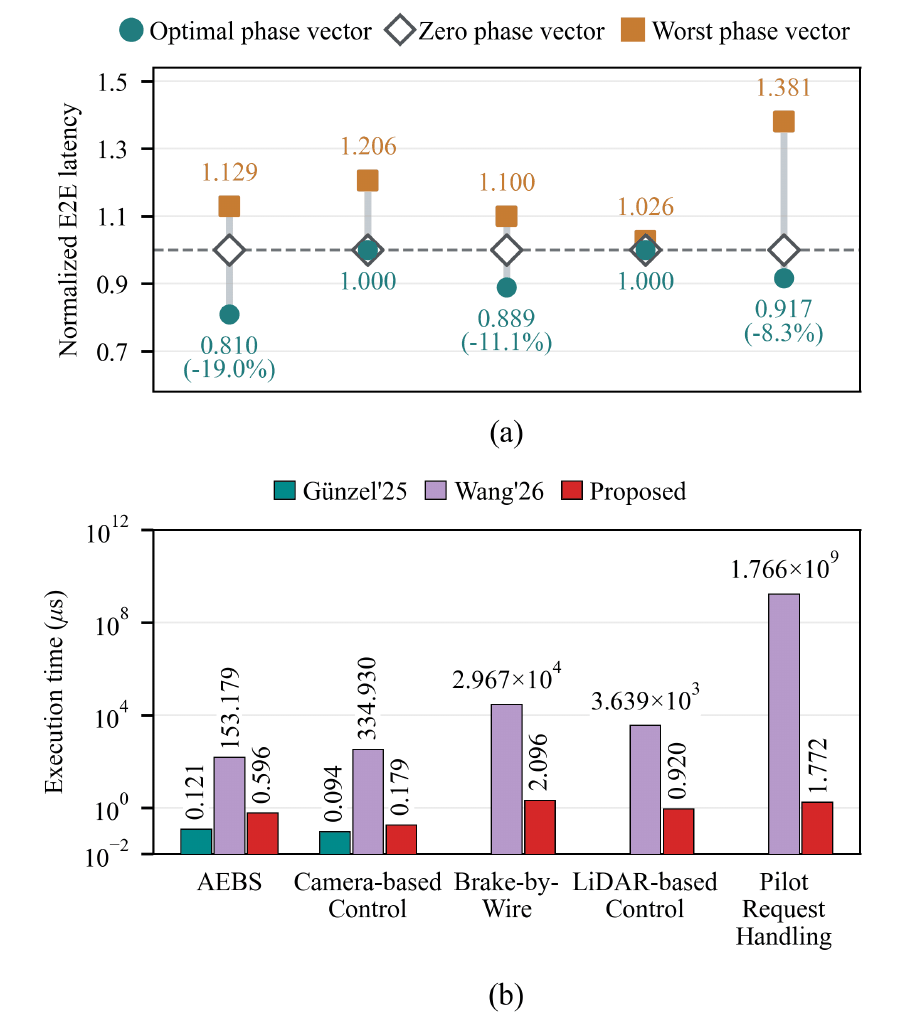
Choosing task phases well matters: for the autonomous emergency braking CEC, the optimal phase vector cuts E2E latency by 19.0% relative to synchronous release. For the seven-task pilot request handling CEC, the enumeration-based method needs about 29.4 minutes (1.766 × 10⁹ µs) to find an optimal phase vector, whereas the proposed method obtains the same minimum E2E latency in 1.772 µs.
Contributions
- A finite, optimality-preserving set of candidate phases for a task that extends a subchain with fixed phases, derived from a zero-wait alignment principle (Theorem 1).
- A depth-first branch-and-bound algorithm that finds an optimal phase vector and its E2E latency without harmonicity assumptions, starting from a maximum-period task and accelerated by singleton acceleration and lower-bound pruning (Theorem 3).
- Closed-form lower and upper bounds on the minimum E2E latency (Theorem 2).
- A proof that the zero phase vector is optimal for CECs satisfying a divisibility condition, which every two-task CEC satisfies, with their minimum E2E latency in closed form (Corollary 4).
Submission History
| Version | Date | Note | File |
|---|---|---|---|
| v1 | Sat, 21 Nov 2026 | Submitted to IEEE TCAD | PDF, 3.4 MB |
How to Cite
J. Lee, N. Lee, S. Kim, and S. Hong, “Accelerated Optimal Task Phasing for LET-Based Cause–Effect Chains,” submitted to IEEE Trans. Comput.-Aided Design Integr. Circuits Syst., Nov. 2026. [Online]. Available: https://pass.hufs.ac.kr/papers/LET-phasing.htm
@unpublished{Lee2026AcceleratedPhasing,
  author = {Jongwon Lee and Namcheol Lee and Saehwa Kim and Seongsoo Hong},
  title  = {Accelerated Optimal Task Phasing for {LET}-Based
            Cause--Effect Chains},
  note   = {Submitted to IEEE Transactions on Computer-Aided Design
            of Integrated Circuits and Systems. Preprint available at
            \url{https://pass.hufs.ac.kr/papers/LET-phasing.htm}},
  month  = nov,
  year   = {2026}
}
This work has been submitted to the IEEE for possible publication. Copyright may be transferred without notice, after which this version may no longer be accessible.